
The OncoMetastat® Technology
OncoMetastat® is built on an advanced approach to capture, study, and deplete circulating tumor cells (CTCs)—the drivers of metastasis. By focusing on tumor cell dynamics in the blood, the platform enables deeper insights into disease progression and supports strategies aimed at delaying cancer metastasis in early stage cancers..
Core Technology
Precision engineering
for CTC depletion.
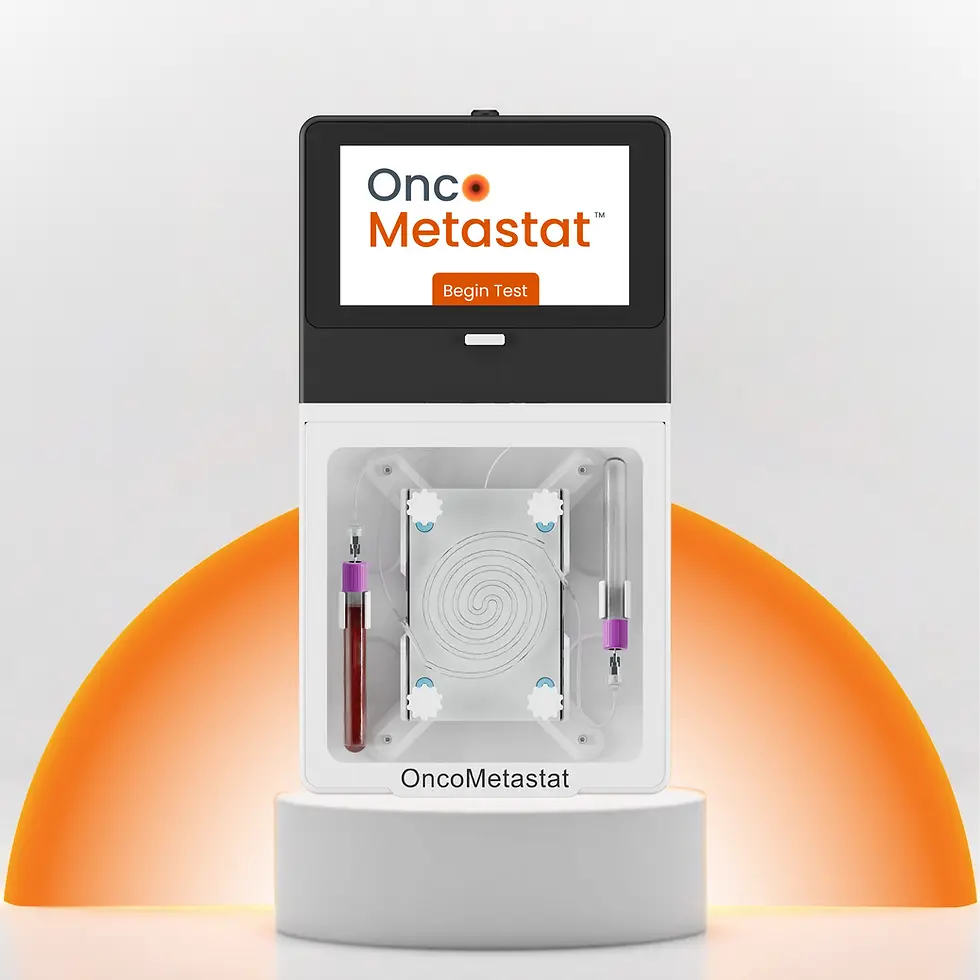
OncoMetastat® is an investigational extracorporeal blood-processing platform, inspired by blood-dialysis principles, and envisaged to selectively capture and deplete circulating tumor cells (CTCs) from a patient’s blood while maintaining blood integrity. Designed with a focus on precision and safety, the prototype is currently under evaluation for its potential research relevance to metastasis and broader cancer management.

Spiral Filtration System
Spiral channel housing CTC-capturing glass beads 3D printed with biomedical grade resin can filter 1-10 ml clinical blood sample.

Affinity Based System
Ligand-conjugated glass beads designed to capture circulating tumor cells (CTCs) for investigational evaluation. Ligands are EpCAM, Transferrin and N-Cadherin.

Biocompatible Design
Constructed from non-immunogenic materials to support durability and biocompatibility testing.

Built-in Safety Controls
Includes provisions for anti-coagulant handling and mixing systems during prototype testing.

Continuous Automated Operation
Designed to model gentle, continuous and automated blood circulation similar to dialysis principles for investigational use.

Algorithmic Image Analysis
Use of image processing algorithms for automated cell quantification and counting.

Process
How OncoMetastat® works.
A closed-loop, extracorporeal process designed for gentle, continuous CTC depletion.
Blood Collection
A clinical blood sample (1–10 ml) is collected via a standard BCT (Blood Collection Tube) and loaded into the cartridge through the aspirator needle system.
Spiral Channel Processing
The peristaltic pump circulates blood through the 3D-printed spiral channel plate. The stage vibrator ensures continuous, uniform flow and prevents bead aggregation.
Affinity-Based CTC Capture
EpCAM, Transferrin, and N-Cadherin conjugated glass beads selectively bind circulating tumor cells as blood passes through the bead matrix.
Effluent Return & Analysis
Processed blood exits via the effluent line. Captured CTCs on the glass bead substrate are then stained and quantified using CK18/DAPI fluorescence imaging.
